
← Back to Blogs
December 20, 2020 · 5 min read
Software Development
The Biggest Software Development Trends to Follow in 2026
The biggest software development trends in 2026 combine AI, edge, cloud-native engineering, and automation to help businesses scale faster and stay competitive.
By Joseph Mitch, CTO of KeY2Moon Solutions
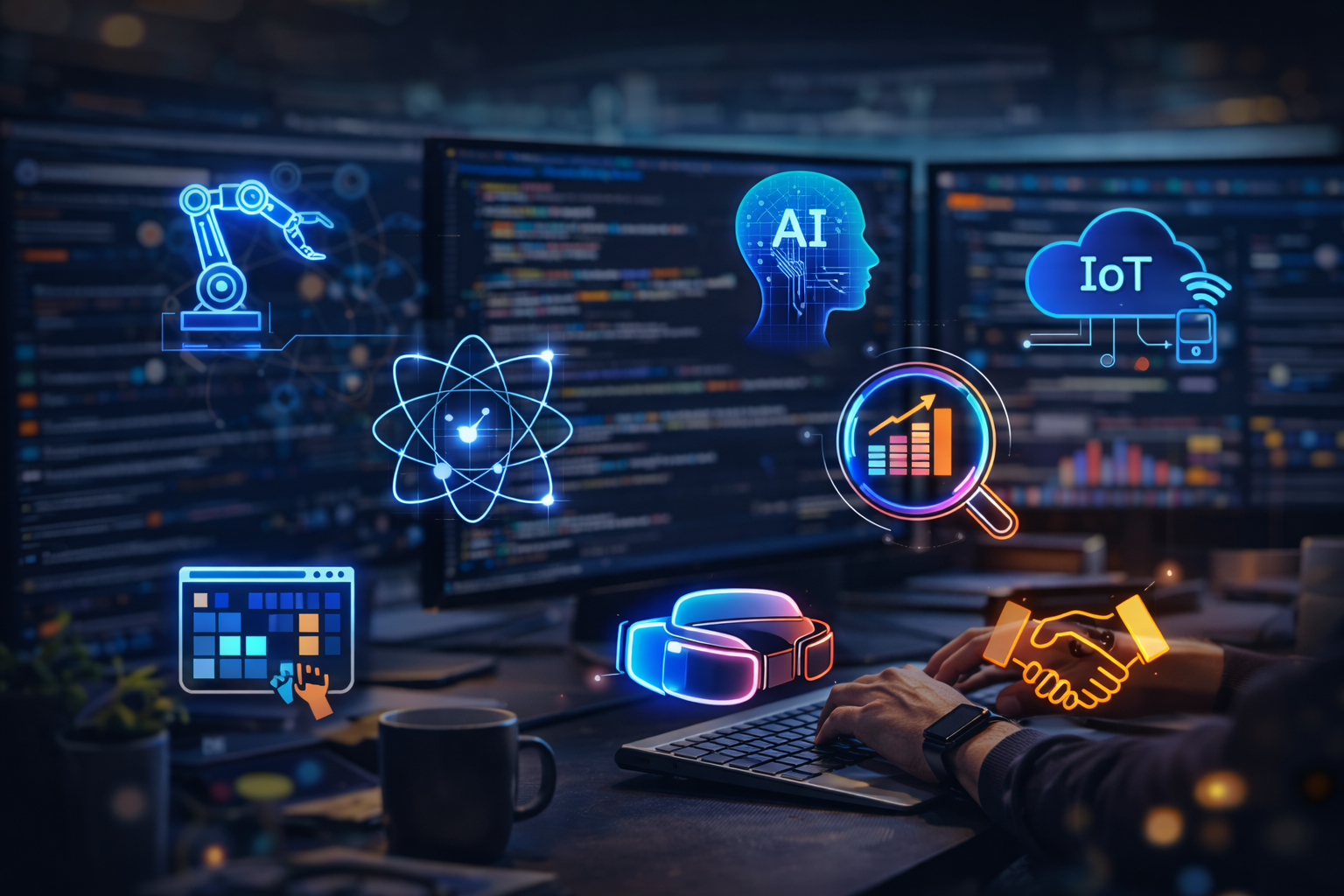
KeY2Moon Solutions shares practical insights on The Biggest Software Development Trends to Follow in 2026 to help technology leaders improve delivery speed, software quality, and long-term business resilience.
As time moves forward, businesses discover new opportunities and technologies. Building with modern tools is critical for delivering better customer experience and sustainable growth.
Companies that fail to adapt to software engineering trends lose relevance, fall behind competitors, and reduce their long-term potential.
In this article, we outline the trends shaping software development in 2026 and how they are changing the way products are built, deployed, and scaled.
Software Development Trends That Are Staying With Us
Several software development trends continue to transform how organizations operate and deliver value. These are not short-lived experiments. They are structural changes in the technology ecosystem.
Artificial intelligence
Prospective industries: Businesses of all sizes and sectors.
AI remains a foundational trend, from healthcare breakthroughs to enterprise automation. Decision intelligence, AI engineering, and generative AI are now practical areas of investment.
Key focus areas
• Automated decision-making powered by integrated data and analytics.
• AI engineering practices that connect models, data, and delivery pipelines.
• Generative AI for content, coding support, and process acceleration.
Techstack case
Industry: Digital transformation.
We transformed test case management by implementing an AI assistant that analyzes requirements and updates test cases through a Slack command.
Challenges
• Managing 800+ test cases efficiently.
• Reducing manual effort and human error.
• Accelerating releases while keeping quality high.
Results
• Processed 2,000+ test cases in parallel.
• Reduced updates from hours to minutes.
• Shifted QA effort from repetitive updates to strategic testing.
AR/VR and metaverse
Prospective industries: Entertainment, healthcare, e-commerce, media.
AR/VR is regaining momentum through practical use cases and metaverse-driven demand. In healthcare, AR/VR supports telemedicine, training, and patient care. In entertainment and commerce, immersive experiences are creating new engagement models.
Big Data
Prospective industries: Energy, automotive, financial services, manufacturing.
Data strategy in 2026 focuses on data fabrics and cross-platform data sharing across ecosystems and supply chains. Better data interoperability drives faster insight and better decision quality.
Internet of Things
Prospective industries: Agriculture, renewable energy, manufacturing, supply chain.
IoT and edge computing remain central to real-time monitoring and optimization.
Key focus areas
• Smart IoT solutions reducing resource waste.
• Industrial IoT sensors enabling predictive analytics and tracking.
• Energy monitoring for solar, wind, and grid optimization.
Techstack case
Industry: Manufacturing.
We built an IoT solution with humidity sensors, temperature sensors, and infrared cameras for real-time production monitoring.
Results
• Continuous monitoring without production interruption.
• Reduced downtime through early issue detection.
• Cost savings from optimized cooling and maintenance planning.
Cybersecurity
Prospective industries: Automotive, financial services, healthcare.
As cloud, IoT, and AI usage expands, cybersecurity threats become more sophisticated.
Priority capabilities
• Zero-trust architecture.
• Cybersecurity mesh integration.
• AI-assisted threat detection and response.
• Quantum-resistant cryptography planning.
Robotics and drones
Prospective industries: Agriculture, automotive, healthcare, military.
Hyperautomation is accelerating robotics and drone adoption across sectors. Organizations use robotics to automate repetitive or high-risk tasks and improve precision and safety.
The New Tech Playbook
Several technologies have moved from emerging to operational in enterprise environments.
Progressive web applications (PWA)
Prospective industries: Retail, e-commerce, media.
PWAs combine strengths of web and mobile, improving speed and engagement without app store dependency. Browser support and platform tooling are now mature enough for broad adoption.
5G technology Prospective industries: Telecommunications, IoT, smart cities, healthcare, manufacturing.
5G delivers low latency, high bandwidth, and high connection density, enabling more reliable real-time systems.
Current state highlights
• Global rollout has reached critical scale in developed regions.
• Private 5G adoption is growing in industrial environments.
• Edge + 5G use cases are expanding across logistics and manufacturing.
Edge computing
Prospective industries: IoT, AI, cloud computing.
Edge computing brings compute closer to data sources for lower latency, lower bandwidth costs, and stronger privacy controls.
Low-code/no-code development
Prospective industries: Software development, startups, enterprises.
Low-code platforms now support advanced workflows, AI integrations, and production use cases. Many organizations use them to accelerate internal tooling and process automation.
Quantum computing
Prospective industries: Finance, healthcare, research, cybersecurity.
Quantum computing is still early but advancing. Investment is increasing, cloud access models are improving, and practical use cases in optimization and cryptography research continue to grow.
Microservices architecture
Prospective industries: Software development.
Microservices remains a key architecture pattern for scalability, team autonomy, and independent deployment.
IoB (Internet of Behavior)
Prospective industries: Marketing, healthcare, retail.
IoB uses behavior data to personalize experiences and improve outcomes. Adoption is growing, while privacy regulation increasingly shapes implementation.
Outsourcing development
Prospective industries: Startups, SMBs, enterprises.
Outsourcing continues to evolve toward strategic long-term partnerships, nearshoring models, and specialized teams for AI, blockchain, cloud, and IoT delivery.
Emerging Convergence of Software Development Trends
Powerful outcomes increasingly come from combining trends
• Edge AI + 5G + IoT for real-time intelligent systems.
• PWA + Low-code for fast delivery of capable web products.
• Microservices + Serverless + Low-code for scalable systems with lower operational burden.
• Quantum + AI for advanced optimization and simulation.
• IoB + Edge computing for low-latency behavioral insight with stronger privacy controls.
Let’s Shape the Future Together
These software development trends provide a practical roadmap for the next stage of digital growth.
Organizations that adopt the right technologies early can improve customer experience, increase operational efficiency, and build long-term competitive advantage.
If you want to future-proof your product, we can help you evaluate, prioritize, and implement the technologies that match your business goals.
How this applies to your IT roadmap
For technology leaders, success comes from turning strategy into repeatable execution. KeY2Moon Solutions helps product and engineering teams convert architecture, security, and delivery goals into reliable implementation plans.
• Technology consulting aligned to product and business priorities
• Custom software engineering for scalable digital platforms
• Cloud, DevSecOps, and modernization support for enterprise teams
“Build for resilience, deliver with confidence, and scale with KeY2Moon Solutions.”
If your organization is planning initiatives in software development, software modernization, DevSecOps, cloud architecture, or custom product engineering, KeY2Moon Solutions can help define the right next steps.
Software Development
IT Consulting
DevOps
Cloud Strategy
Need help applying this to your product?
Reach out and we can map these concepts to your roadmap, team structure, and platform constraints.